

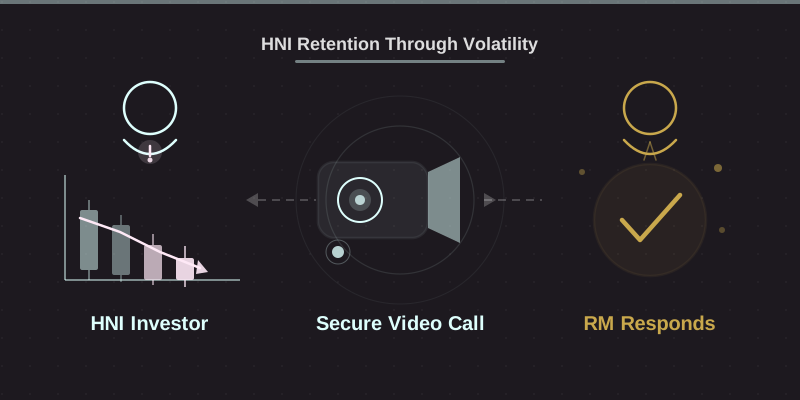
October 2024. Foreign institutional investors pulled out Rs 94,017 crore from Indian equities in a single month, the highest monthly outflow on record. The Sensex, which had touched 85,978 in September, was sliding fast. Phones at wealth management firms were ringing off the hook.
Some relationship managers answered every call. They explained the situation, walked clients through their portfolios, and gave them a reason to stay calm and stay invested. Their clients held on.
Others sent a mass email. Their clients started looking for someone better.
This is the moment that defines HNI wealth management in India. Not the bull market, when everyone looks clever. The correction. The panic. The 11 PM message that says “should I sell everything?” How a firm responds in that moment determines whether a client stays for a decade or transfers their assets to a competitor by the end of the quarter.
Secure video banking is the infrastructure that makes the right response possible, at scale, every single time.
Why HNI Retention Is the Most Important Problem in Indian Wealth Management Right Now
India’s HNI population crossed 850,000 individuals with assets above USD 1 million and is on track to approach 1.65 million by 2027, according to the Knight Frank Wealth Report 2025. A Deloitte India report from January 2025 estimates that Indian wealth management AUM will nearly double from USD 1.1 trillion in FY24 to USD 2.3 trillion by FY29. That is a USD 1.6 trillion growth opportunity in five years.
But here is the catch. India has roughly 10 million rupee-millionaire households and only around 11,000 relationship managers, according to Sandeep Jethwani of Dezerv, speaking at a 2026 industry forum. That is approximately 1,000 wealthy families per relationship manager. The supply of human advisory attention is nowhere near the demand.
Meanwhile, HNI expectations are rising sharply. A 2026 survey by 360 ONE Wealth found that over 60 percent of new HNIs in India today are first-generation wealth creators: GCC executives, startup founders, consultants who built their wealth themselves. These clients expect institutional-grade products, full transparency on fees and risks, and a digital experience that matches consumer apps. They are not patient with firms that offer slow responses and generic communication during market stress.
The Marcellus India Wealth Survey 2025 found that 40 percent of HNI respondents expressed dissatisfaction with their investment returns. That dissatisfaction is a churn signal. When markets fall, clients who already feel underserved do not wait for conditions to improve. They move.
The firms that retain HNI clients through volatility are the ones that make those clients feel seen, heard, and genuinely advised during the moments of stress, not after. Secure video is what makes that possible when a relationship manager cannot be in the same city as a client.
What HNI Clients Actually Need During a Market Downturn
Before discussing the technology, it helps to understand the psychology.
An HNI investor during a sharp market correction is not primarily worried about their portfolio percentage. They are worried about whether they made a mistake in trusting their advisor. They are worried about whether they should have moved to cash earlier. They are worried that the person managing their wealth does not fully understand their situation.
What they need in that moment is not a report. It is not an automated push notification. It is a real conversation with someone who knows their portfolio, understands their goals, and can explain clearly what is happening and why it does not require panic.
Research on HNI relationship management consistently identifies five things that matter most to high-value clients: personalised interaction, proactive problem-solving, regular check-ins, transparency about fees and risks, and emotional intelligence that addresses the human side of wealth management, not just the financial side.
A phone call can deliver some of this. An email delivers almost none of it. A secure video session delivers all five simultaneously.
When a relationship manager sits face-to-face with a client on video, they can read the client’s body language and tone. They can share their screen to show portfolio breakdowns in real time. They can walk through a scenario analysis. They can answer follow-up questions immediately. And they can do this from anywhere, at any hour that works for the client, without either party needing to travel.
How Secure Video Changes the HNI Advisory Model
Real-Time Portfolio Reviews When It Matters
The traditional model for HNI wealth management runs on scheduled quarterly reviews. The client visits the RM’s office or the RM visits the client’s home or office. This works in stable markets. In volatile ones, it is completely inadequate.
A client watching their portfolio drop 8 percent in a week does not want to wait for the next quarterly meeting. They want a conversation now. With a video branch available as a channel, the RM can schedule an emergency review within hours. Both parties connect on a secure encrypted call. The RM shares their screen, walks through the portfolio, explains the market context, and documents the conversation as part of the client record.
This is not just better for the client. It is also better for the firm. A documented video conversation, timestamped and stored securely, provides a clear record of what advice was given, when, and in what context. This matters enormously for compliance and, in disputes, for protection.
Onboarding New HNI Clients Without Friction
Gaining a new HNI client during a period of market stress is one of the highest-value moments in wealth management. A high-net-worth individual who is leaving a competitor because they felt neglected during the correction is motivated, ready to transfer assets, and looking for a firm that will treat them differently.
The last thing such a client wants is to be told they need to visit a branch, bring physical documents, and wait two weeks for their account to be set up.
With video KYC, a new HNI client can be onboarded in a single scheduled video session. The RM conducts a live V-CIP call, verifies Aadhaar and PAN, completes liveness checks, and captures all RBI-mandated data. The account is ready to activate within the same day. The client’s first experience with the new firm is one of speed, professionalism, and respect for their time.
Leading wealth platforms are already building their models around this reality, offering flexible engagement styles: fully managed, co-created, or self-directed, with digital experiences that match what clients get from consumer apps, because that is now the baseline expectation for HNI clients.
Video-Based Advisory for PMS and AIF Discussions
Indian HNIs have significantly increased their exposure to alternative investments, with allocations to private markets growing nearly three times since 2019, according to a 2024 Bain and Co report, with private equity, venture capital, and real assets being the top choices.
These are not simple products. A Portfolio Management Service or an Alternative Investment Fund requires a genuine advisory conversation, not a brochure sent over email. The RM needs to explain the structure, the risk profile, the lock-in implications, and the tax treatment clearly. The client needs to ask questions and feel genuinely satisfied with the answers before committing.
As of January 2026, there are over 206,000 discretionary PMS clients in India managing listed equity AUM of over Rs 3.65 lakh crore, according to SEBI data. Every single one of those relationships began with a conversation. Secure video makes that conversation possible across cities and time zones, with a complete record of what was discussed and agreed.
Video Credit Verification for Margin and Leverage Facilities
Many HNI investors use margin facilities, loan against securities, or structured lending products to manage their portfolios. During volatile markets, these facilities require active monitoring and, sometimes, rapid restructuring.
When a client’s margin position needs a review or a new credit facility needs to be set up quickly, video-based credit verification allows the lending team to conduct the necessary verification and discussion in a single live session. Documents can be reviewed on-screen, the client’s identity and intent can be verified, and the decision can be made and communicated in hours rather than days. For HNI clients who are managing complex, multi-asset portfolios, this speed matters enormously.
The RM Capacity Problem and How Video Solves It
India is creating wealth faster than the industry is creating or training relationship managers. With roughly 10 million rupee-millionaire households and about 11,000 relationship managers, technology is the only way RMs can serve their clients well. An RM today has to juggle many time-consuming non-client-facing tasks, when that time could be spent addressing client queries, deepening relationships, and providing genuine advice.
A field-visit model makes this problem worse. When an RM spends half their day travelling to meet two clients, they are not available to the other clients who need them. Video removes the travel equation entirely.
One RM using a video channel can conduct more meaningful client interactions in a week than they could in a month through physical visits alone. They can do a 30-minute portfolio review at 8 AM before markets open. They can take an urgent call from a client in Ahmedabad at lunchtime. They can do a product pitch to a new prospect in Bengaluru at 6 PM. None of this requires leaving the office. All of it creates documented, high-quality advisory records.
This is not about replacing the human relationship. It is about removing the logistical friction that prevents human relationships from happening frequently enough.
What HNI Clients in 2026 Expect From a Wealth Platform
Among HNI women investors surveyed in 2026, trust and transparency are non-negotiable, with 75.1 percent prioritising full transparency on fees, risks, and conflicts above even investment performance or technical capability. At the same time, 68.6 percent are comfortable with AI tools as long as human advisors remain central to the relationship.
This tells wealth platforms exactly what the modern HNI client wants. They want the efficiency and speed of technology combined with the trust and depth of a human advisor. They are not asking for a chatbot. They are asking for their RM to be more available, more transparent, and more responsive.
Secure video is the channel that delivers this combination. It uses technology as the infrastructure while keeping the human relationship at the centre of every interaction.
Building a Video-First HNI Service Model: What Firms Need to Consider
Dedicated video channels for HNI clients only. A general customer service video line does not meet the expectation of an HNI relationship. Clients at this level expect a dedicated RM who knows their portfolio and is available specifically for them.
Session recording and compliance documentation. Every video advisory session should be recorded, time-stamped, and stored securely within India under DPDP Act 2023 requirements. This protects both the client and the firm.
Proactive scheduling, not just reactive calls. The best use of video in volatile markets is proactive. RMs should reach out with scheduled video reviews before clients feel the need to call, not after the anxiety has built up.
Integration with portfolio management systems. RMs should be able to pull up a client’s complete portfolio view during a video call, share their screen, and make notes that feed directly into the client record system.
Training for video advisory conversations. A video call is different from a phone call and different from an in-person meeting. RMs need training in how to read the screen-based conversation, how to present portfolio data clearly on camera, and how to handle emotionally charged discussions with anxious investors through a video interface.
The Opportunity for Indian Stockbrokers and Wealth Platforms
As of October 2025, India has nearly 13.6 crore investors holding more than 21 crore demat accounts, with approximately one lakh new demat accounts being opened every single day, according to SEBI Chairperson Tuhin Kanta Pandey.
Within this enormous and growing investor base, the HNI segment represents the highest revenue per client, the highest referral value, and the highest switching risk. A single HNI client who moves their portfolio to a competitor during a market downturn does not just take their assets. They often take two or three other clients with them through their network.
The firms that invest in video-based advisory infrastructure now are building a retention advantage that compounds over time. Every market correction that happens while that infrastructure is in place becomes a moment to strengthen client relationships rather than lose them.
The question for every wealth platform and stockbroker in India serving HNI clients is not whether to build this capability. It is whether to build it before the next correction or after it.
Frequently Asked Questions
Why do HNI clients churn more during market volatility? Volatility exposes gaps in the advisory relationship. When a portfolio is growing, clients are generally satisfied. When it falls sharply, clients assess whether they are genuinely being advised or simply being held in products. Clients who feel their RM is unavailable or uninformed during a downturn often conclude that they are in the wrong place and begin the transfer process.
How is a video advisory session different from a regular phone call? A video session allows the RM to share their screen and show live portfolio data, read the client’s emotional state through visual cues, present charts and scenario analyses in real time, and create a documented, time-stamped record of the full conversation. A phone call provides none of these. The depth and quality of the advisory exchange is significantly higher on video.
Is video KYC valid for onboarding HNI clients in India? Yes. The RBI’s V-CIP framework, updated through the November 2025 KYC Master Directions, allows full customer identification and verification through a live encrypted video session. This applies to all categories of customers including HNIs and is treated as equivalent to a face-to-face branch verification.
How do wealth platforms ensure privacy for HNI clients during video sessions? A compliant video banking platform encrypts all sessions end to end, stores recordings within India under DPDP Act 2023 requirements, and transfers all session data to the firm’s own systems immediately after the call. No session data remains on the vendor’s servers.
Can video banking handle complex HNI products like PMS, AIFs, and structured products? Yes. The video channel is not product-specific. It supports any advisory conversation, including detailed product explanations for complex instruments, portfolio reviews covering multiple asset classes, loan and margin discussions, and onboarding for new investment structures. The compliance recording is equally valuable across all of these.
How does video reduce the RM-to-client ratio problem? By removing travel time, an RM using video can conduct significantly more meaningful client interactions per week than one relying on physical meetings. This does not replace the depth of the relationship but removes the logistical constraint that prevents frequent, high-quality client contact.
What is the minimum technology setup required for an HNI client to use video banking? A smartphone with a standard 4G connection is sufficient. Most video banking platforms work through a browser link sent via SMS, requiring no app download. This makes it accessible for clients across age groups and locations without any technical setup on the client’s side.