





Ask three vendors what Video KYC costs and you will often get three answers that are hard to compare. One quotes a rate per session, another a monthly licence, a third a large figure for an on premise deployment. None of them is wrong, but none of them tells you what you really want to know, which is what this will cost your institution at your volumes, and whether the cheapest headline number is actually the cheapest outcome.
This guide unpacks how Video KYC is priced, what sits behind the numbers, and how to read a quote so you are comparing value rather than just rate. It is written for the person who has to defend the spend, not sell it.
The short answer
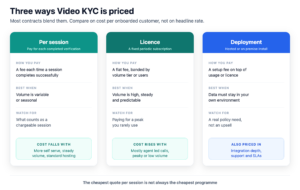
- Video KYC is usually priced in one of three ways: per successful session, a periodic licence or subscription, or a deployment fee for hosted or on premise installations. Many real contracts blend them.
- The headline rate is only part of the cost. What actually drives your bill is your volume and its shape, how much of the work is assisted versus self serve, your hosting and security requirements, and the integration and support you need around the core.
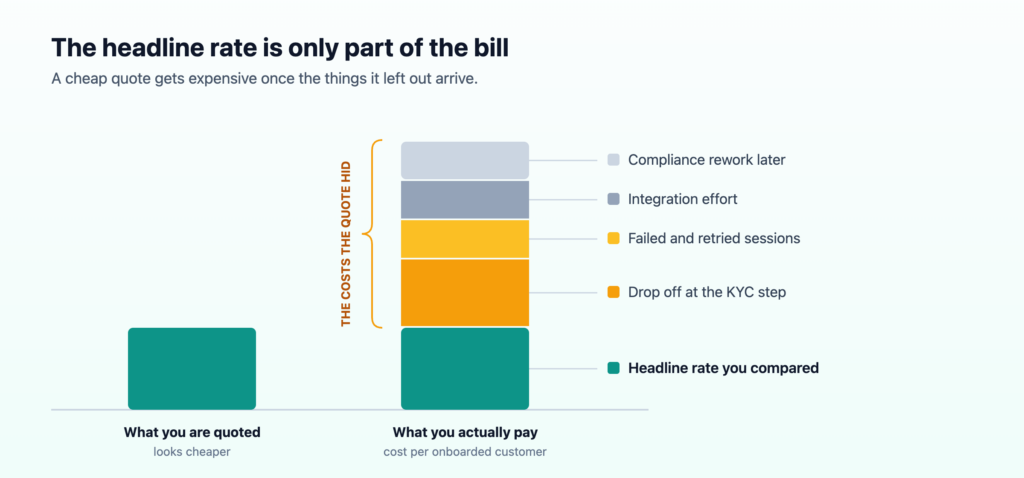
- The cheapest quote per session is not always the cheapest programme. The right lens is cost per successfully onboarded customer, including the accounts a weaker flow would have lost to drop off.
The three pricing models you will meet
Per session pricing
The most common model charges a fee each time a verification session runs, often only when it completes successfully. It is easy to understand, it scales cleanly with your business, and it means you pay for outcomes rather than shelf space. For an institution with variable or seasonal volume, this keeps cost tied to activity.
The point to check is what counts as a chargeable session. A model that charges for every attempt, including abandoned or failed ones, behaves very differently from one that charges only for completed verifications. Ask where the line sits before you compare two per session rates, because the same number can mean two different bills.
Licence or subscription pricing
Here you pay a fixed periodic fee, often banded by volume tier or number of users, for access to the platform. This suits institutions with steady, predictable throughput that want a flat, forecastable line in the budget rather than a figure that moves with the month. At high and stable volumes, a licence can work out cheaper per session than a pure usage rate, because the platform cost is spread across a large, reliable base.
The trade is flexibility. If your volume is lumpy or still growing, a licence sized for your peak can leave you paying for capacity you do not always use.
Deployment and hosting pricing
Some institutions, particularly larger banks and insurers with strict data policies, need the platform hosted a specific way, whether in a private cloud or fully on premise inside their own environment. This typically carries a deployment or infrastructure component on top of usage or licence fees, reflecting the dedicated setup, hosting and hardening involved.
This is not an upsell so much as a different shape of requirement. If your policy demands that customer data never leaves your own infrastructure, the hosting model is part of the compliance answer, not an optional extra, and it should be priced as such from the start.
What actually drives your cost
Two institutions can adopt the same platform and see very different bills. The variables that move the number are these.
Cost driver | Lower cost when | Higher cost when |
|---|---|---|
Monthly volume | High and steady, spreading fixed cost | Low or highly seasonal |
Assisted vs self serve mix | More self serve, less agent time | Mostly agent led sessions |
Hosting model | Shared or vendor hosted | Private cloud or on premise |
Integration depth | Standard APIs and SDK | Heavy custom integration work |
Support and SLAs | Standard support tier | High touch, guaranteed response |
Add on checks | Core verification only | Extra data and risk services layered on |
Volume and its shape
Volume is the biggest single lever, but its shape matters as much as its size. A steady flow lets a vendor price keenly. Sharp, unpredictable peaks, a festival lending season, a product launch, need capacity that has to exist whether or not it is used, and that reality shows up somewhere in the price. When you share your numbers with a vendor, share the pattern, not just the total.
The assisted to self serve mix
An agent led session costs more than a self serve one, because it consumes a trained officer’s time. The proportion of your journeys that genuinely need a human is therefore one of the strongest cost levers you control. A flow that routes only the cases that require judgement to an agent, and clears everyday volume through a self serve session, lowers the average cost per session without lowering assurance where it counts. This is why routing is a pricing question as much as a product one, and it is worth pressing a vendor on how fine that control really is. A platform like VideoCX.io lets you set the dial per product and per risk band through its customer journey and routing engine rather than run everything through an agent, so your average cost tracks your actual risk instead of your most cautious default.
Hosting, security and integration
On premise hosting, private deployments, deep custom integrations and elevated support tiers all add cost, and all can be entirely justified. The mistake is to treat them as line items to trim rather than requirements to meet. The right question is not how to remove them, but whether each one reflects a genuine policy or scale need. Where it does, it belongs in the quote. Where it does not, it can go. This is also where it helps to work with a platform that offers the full range rather than forcing one shape on you: VideoCX.io, for example, sets out its hosting and pricing options across cloud and fully on premise, so an institution whose policy demands that customer data never leaves its own environment is not paying for a workaround, and one with lighter requirements is not paying for infrastructure it does not need.
The hidden costs the headline rate hides
A quote that looks cheap can become expensive once the things it left out arrive. Watch for these.
- Drop off. A clumsy flow that loses applicants at the video step has a real cost that never appears on the invoice: the accounts you did not open. A slightly higher per session rate that completes far more sessions is usually the cheaper choice.
- Failed and retried sessions. If poor connection handling or weak guidance forces customers to restart, you may pay for the extra attempts and lose some of those customers along the way.
- Integration effort. A platform without clean APIs and an SDK shifts cost onto your own engineers to make it fit, which is real spend even though the vendor never bills it.
- Compliance rework. A flow that does not keep pace with regulation can force re engineering later, or worse, leave you exposed. The cost of that is not a rate, it is a risk.
How to compare quotes fairly
The way to cut through the noise is to stop comparing rates and start comparing outcomes. A few habits help.
- Translate every quote into an estimated cost per successfully onboarded customer at your real volume and your real assisted to self serve mix, not the vendor’s illustrative one.
- Confirm exactly what triggers a charge, so two per session numbers are actually the same thing.
- Ask what is included versus added: liveness, face match, location check, document checks, recording, storage, support and updates should be clear, not discovered later.
- Weigh the completion rate the flow achieves, because a platform that onboards more of your applicants is doing revenue work a cheaper one is not.
Read this way, the lowest number and the best value are often not the same quote, and you will be able to show exactly why. A price built around your real volume, your real routing mix and your real hosting need, which is how VideoCX.io prefers to quote, is one you can defend on cost per onboarded customer rather than headline rate.
If it would help to size Video KYC against your own numbers, you can see the VideoCX.io platform and its APIs or talk to our team about a quote built around your volumes and hosting needs.