





A fintech lives or dies on how fast it can turn a curious visitor into an active customer. The whole promise is that everything happens on the phone, in one sitting, without a physical form to submit or a branch to visit. Then the flow reaches identity verification, and for many digital businesses that is exactly where the promise wobbles. The customer who signed up in seconds is suddenly asked to prove who they are, and if that step is slow or clumsy, a large share of them simply leave.
Video KYC is how the sharper fintechs and neobanks keep the speed without cutting the compliance. This guide looks at why the KYC step is the make or break moment for digital finance, how video verification fits an app first business, and what a well built flow does to protect both conversion and compliance at once.
The short answer
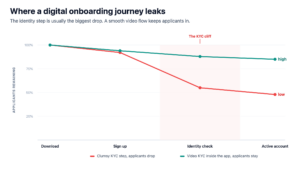
- For a fintech or neobank, the KYC step is usually the single biggest drop off point in onboarding, because it interrupts an otherwise instant experience.
- Video KYC lets a fully digital business complete regulator accepted identity verification inside the app, in minutes, without a branch or a courier.
- Done well, it turns compliance from the thing that slows onboarding into a step the customer barely notices, which protects conversion and satisfies the regulator in the same session.
Why KYC is the hardest step in a digital journey
Everything before verification is designed to feel effortless. A customer downloads the app, enters a few details and is moments away from being onboarded. Then comes the part that cannot be waved through: the business has to be sure this is a real, identified person, because the rules for opening an account or extending credit demand it, and because the cost of getting it wrong is fraud and regulatory exposure.
This is where digital finance feels the tension most sharply. A neobank has no branch to fall back on. A digital lender is often reaching customers a traditional bank never served, in towns without a nearby office. The very thing that makes these businesses efficient, the absence of physical infrastructure, means the verification has to happen remotely or not at all. If the remote flow is weak, the customer waits, gets frustrated and drops, and every dropped customer was a full acquisition cost already spent.
So for a fintech the KYC step is not a compliance formality bolted on at the end. It is a conversion event, and often the one that decides whether the business grows at the speed its model needs.
How Video KYC fits an app first business
Video KYC resolves the tension by making the compliant step also the fast one. In a single guided session inside the app, the platform confirms a live person is present, captures a live photograph, reads and validates identity documents, matches the face to the document, records the customer’s location and stores the whole interaction as a tamper evident file. Because the Reserve Bank of India accepts video based verification as equivalent to meeting the customer in person, the account that results is fully enabled, not a limited one waiting on a further step.
For an app first business, three properties decide whether a video flow helps or hurts, and they are worth using as a checklist when you evaluate a platform. It is these three that drew us to build VideoCX.io the way we did.
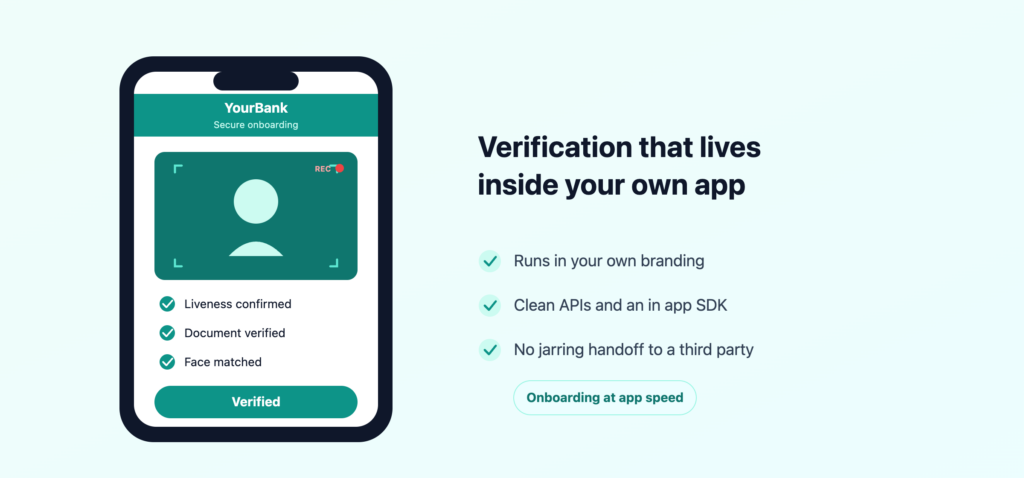
First, the session has to live inside your own product. Through clean APIs and an in app SDK, a VideoCX.io session runs as part of your journey, in your branding, rather than a jarring handoff to something that looks like a different company. The customer never feels they have left your app.
Second, it has to flex between self serve and assisted. High volume, lower risk sign ups complete on their own through a self serve journey, guided by the platform, which is what lets a small team onboard huge numbers without a call centre. Cases that need a human, or a higher value product, are routed to a live agent by the same routing engine. You are not forced to staff for the peak to grow.
Third, it has to hold up at scale and on weak networks, which is the reality of onboarding across India from a single app. This is the property vendors gloss over and customers feel most: the flow has to keep a clean session on a patchy mobile connection and recover gracefully when it stutters, because a dropped call at the identity step is a lost customer. It is exactly the case VideoCX.io is engineered for.
What a good fintech onboarding flow looks like
The best flows feel like one continuous motion to the customer and rigorous underneath to the compliance team. A typical journey runs like this.
- Sign up and prefill – The customer enters a few basics in the app, and verified data is pulled in to reduce typing and error.
- Document and identity capture – The customer presents identity documents, which the platform reads and validates in the session.
- Live verification – Liveness and face matching confirm a real person who matches the document, run self serve for everyday cases or agent led where assurance demands it.
- Compliant remote verification – The video session satisfies the regulatory verification requirement, captured and time stamped.
- Instant activation – The session is stored as a tamper evident record, the checks are logged for audit, and the account or credit line goes live.
The whole sequence can finish in minutes, without the customer ever leaving the app or waiting for a human unless the case genuinely calls for one.
The payoff for a digital business
The gains land exactly where a fintech feels pressure. Conversion at the KYC step rises, because the flow stops being the wall people bounce off. Cost per onboarded customer falls, because there is no branch, no courier and no field agent, and because self serve clears the bulk of volume without agent time. The business can scale into new geographies without building anything physical, since the same app onboards a customer in a metro and one in a small town identically. And the compliance position is stronger, not weaker, because every customer passes through liveness, face matching and a recorded, auditable session rather than a form someone filled in.
For a business whose entire edge is speed and reach, onboarding that is instant and compliant at the same time is not a feature. It is the growth engine, and it is why the KYC step deserves as much product attention as the sign up screen that precedes it.
If you are weighing how a video flow would sit inside your own app, you can explore the VideoCX.io Video KYC platform or talk to our team about your onboarding volumes.
Related reading: Assisted vs Self Serve Video KYC: Choosing the Right Onboarding Model and The Role of Secure Video KYC in Preventing Fraud during Digital Onboarding.